

"Unspoken expectations are premeditated resentments".
Neil Strauss wrote that line in a book about relationships. Turns out, it also applies to running a business.
The reason it applies is something Kahneman and Tversky proved 45 years ago - the psychological pain of a loss feels roughly twice as strong as the joy of an equivalent gain. We are not pleasure-seeking creatures making rational trade-offs. We are discomfort-avoiding ones. The conversations that would create the most value in your business are also the ones that feel the most uncomfortable to have, so you don't have them. You know the one you think about in the shower, draft in your head on the drive home, but never actually start. You handle three lower-value tasks instead and call it a productive day. I'll tell you straight, I'm not immune to this either!
Here's what unspoken expectations actually look like in a founder-led company, across the relationships that matter most. Read these and tell me which one you already knew was about you before you finished the sentence.
Founder to co-founder who stepped back.
You started this business together. But five years in, he pulled back from the day-to-day and the equity split didn't change. Nothing was renegotiated. You just absorbed the role and kept going. Three years later he's effectively a silent partner, except he isn't silent. He likes to weigh in on the big strategic calls with the authority of a 50/50 partner and the context of a part-timer. Still, you haven't said anything because the friendship is older than the business and the original deal felt fair at the time. So, you keep running it as a partnership on paper and a solo show in practice.
Father to daughter in a family business.
He assumes she'll take over. She assumes he'll sell. Both have organized fifteen years of decisions around assumptions the other has never confirmed. And now the family transition planning is paralyzed.
Founder to top-revenue client.
They've been quietly unhappy for nine months. You've sensed it but haven't asked, because asking creates the possibility of an answer. They renew at a reduced scope and you tell yourself it's a market thing. Six months later they're gone, and the postmortem reveals they would have stayed if anyone had just had the guts to ask the right question.
Founder to themselves.
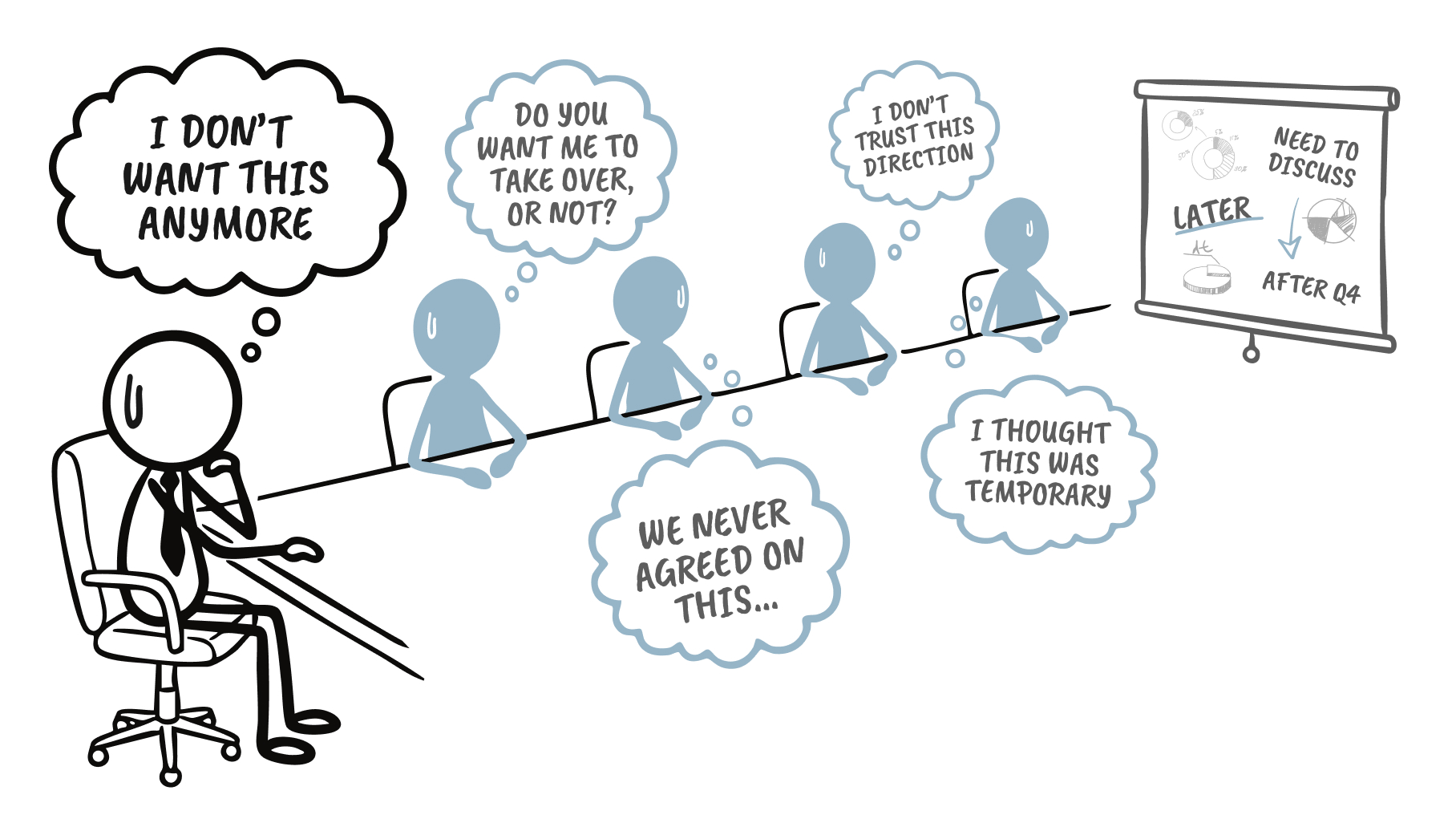
This one may be the most costly. You stopped wanting to run this company about two years ago. You haven't admitted it because admitting it would require deciding what to do next, and you don't know what to do next, and not knowing is unbearable, so you keep grinding to stay busy. You keep being the bottleneck and tell yourself you'll figure it out after Q4. You've told yourself that for eight quarters.
Here's a real story.
A founder called Switch last year and wanted to talk about exit readiness. The business was doing $9M, growing steadily. When I ran the operational diagnostic, it came back as expected. The business was stuck, but fixable. Forty minutes into the call though the real issue surfaced. Her husband, the COO, didn't know she wanted to sell.
They'd built the business together, but somewhere in the last year she had stopped wanting to run a company and started wanting a regular family life again. She hadn't said it out loud. And instead, had been managing what she assumed her partner expected of her - that she should keep building.
The work we did first was to build strategic alignment. We helped them get into one room and name what each of them actually wanted from the next three years - separately, then together. It turned out he didn't expect her to keep building forever. He'd been assuming she expected him to keep going, and was matching her energy. Once the real expectations were on the table, the operational work had somewhere to point, and the business could be rebuilt to give them what they actually came for… options. Sell now, sell in three years, hand it to a GM and step back. None of these options were on the table twelve months earlier, because the business had been built around a conversation neither of them had had.
Look, the conversations you're avoiding aren't separate from your business. They are your business, encoded into hiring decisions, lease commitments, org chart workarounds, and customer relationships that live in one person's head. Every avoided conversation is a discount on your valuation. You don't see the bill until close, but the buyer has priced it in.
There's a question I've started to ask clients when we begin working together: Do you carry an implicit expectation of a key person in your team that might not be clear to them? The answer is almost always yes. Try it now. Write down the names of your top five highest-leverage relationships. Next to each, write the sentence you haven't said. Don't show it to anyone. Just look at the list.
So I'll ask. What's the one conversation you've been avoiding the longest?



.svg)


